














Sound Testing
The Motorcycle Industry Council has put out a manual "Stationary Sound Test Manual" for off-highway motorcycles and all-terrain vehicles which has become the standard as far as AMA is concerned. Included here is the pertinent information regarding sound testing requirements for District 23 off-road events. It is up to each individual rider to know the rules and requirements PRIOR to showing up for an event. If you have any further questions regarding sound testing, send an e-mail to Jay or call 763-263-9835.
**Remember, the noise limits are not just enforced during events, there are laws in place now for riding on both private and public lands. Check the laws at the State and County levels before you ride.
Make the RIGHT IMPRESSION
- Let's face it, noise annoys.
- Know the sound limits where you ride.
- Maintain your exhaust system. Remember that noise doesn't equal horsepower. Too little exhaust back-pressure can actually cause less power and engine damage.
- Keep your RPM and speed down and steady when you're around non-riders.
- Always use a spark arrestor. It doesn't sacrifice power, but can save the forest from fires.
- Protect your right to ride.
Less Sound = More Ground
These are the basic rules followed by AMA District 23 events:
- The area for sound testing must be 30' from buildings, vans, motor homes, trailers or any other sound reflecting surfaces.
- Sound testing requires at least two (2) people. One person to control the sound meter and the other to work with the tachometer.
- Set the sound meter to 'Slow Response' and the 'A Weighting Scale'.
- Nobody should be within 15' of the machine being tested other than the rider and the sound testers.
- When testing in winds above 20 mph position the machine so the wind direction is parallel to the normal direction of the vehicle, exhaust down wind.
- The machine must be in neutral. Rider must be on the machine with both feet on the ground (ATV riders feet can be on the foot rests). The machine must be vertical, stationary, and in neutral.
- Sound meter is to be held at a 45° angle to the exhaust centerline, parallel to the ground and 20" to the rear of the exhaust outlet at the same height as the exhaust outlet.
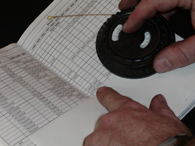 Determine the RPM for make, model and year from the Motorcycle Industry Council tables. Set vibrating tachometer to test the RPM's.
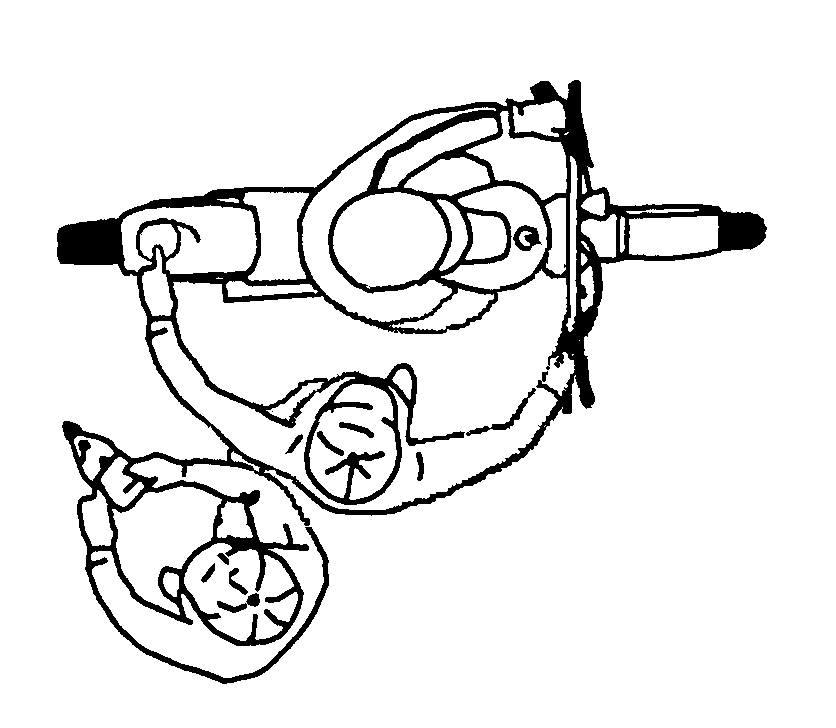 Hold tachometer flat on rear fender with your index finger in the center of the tachometer.
- The tachometer operator must be in a position to hold the tachometer on the rear fender and operate the throttle simultaneously.
- The sound meter operator must be positioned on the same side as the tachometer operator with their right foot positioned so that the tachometer operator can tap the top of the sound meter operator's foot when the target testing RPM is attained. (yelling potentially could affect the reading)
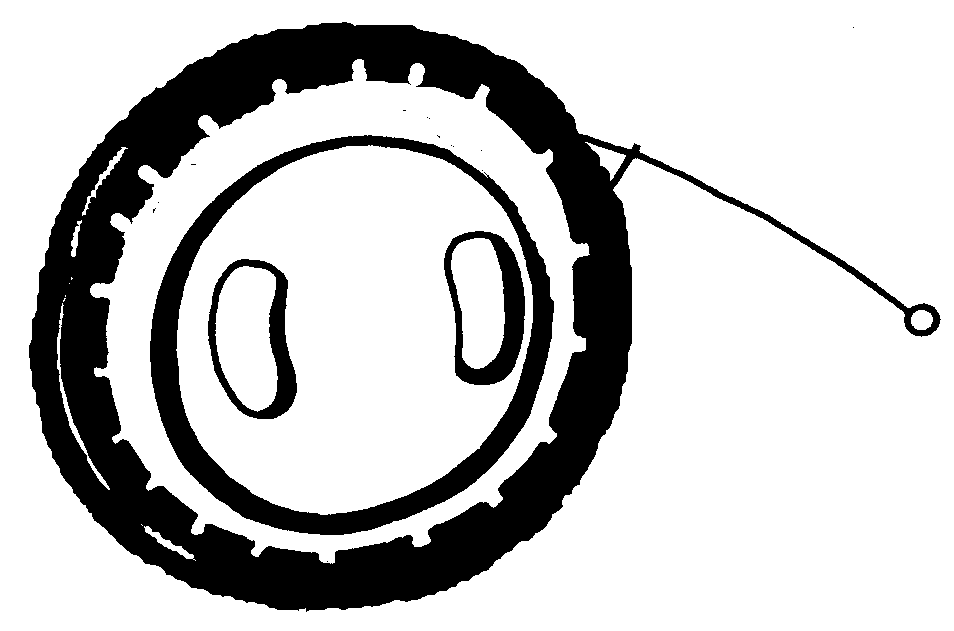 When the tachometer has reached the target RPM, the oscillating wire on the tachometer will swing in a figure eight (8) configuration. There are some machines, like small four-strokes, which don't vibrate much. These machines are tested when the yellow loop (at the end of the wire) is at its widest arc (when it is vibrating the most). *NOTE: Some small four-strokes have a vibration spot just off idle, this will give a false reading.